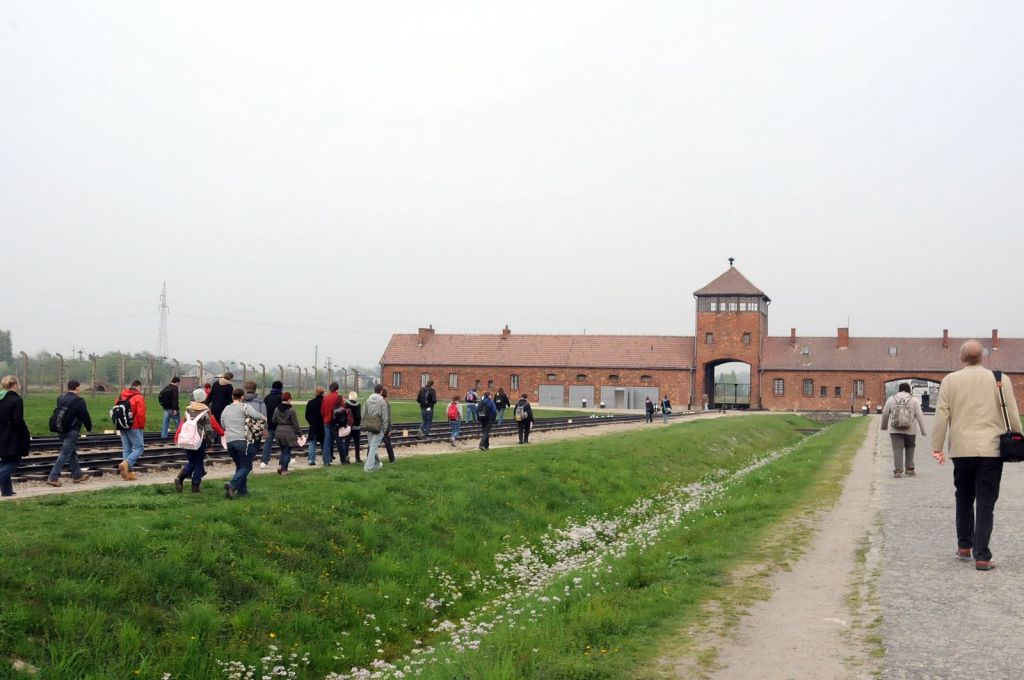
January 2025 marks the 80th anniversary of the liberation of Auschwitz-Birkenau. Back in 2009, as a regional journalist on the Bristol Evening Post, I travelled to the site of the former concentration camp with a group of West Country students as part of a project to ensure the horrors of the holocaust do not get forgotten. To mark the 80th anniversary, it feels appropriate to look back at the experience. Here’s what I wrote for the Bristol Evening Post back in 2009:
It isn’t walking in, it’s walking out of an Auschwitz gas chamber that sickens you most. As you enter, you sense you are standing shoulder-to-shoulder with the countless thousands who trod this grisly path to their death 60 years ago. But walking out, you feel alone. This was the door they never reached.
Standing back outside in the dusty road, you find yourself appreciating the little things. Breathing the air. The tingle of the sun on your face. The sound of the birds, which seem to sing constantly in the trees around Auschwitz-Birkenau.
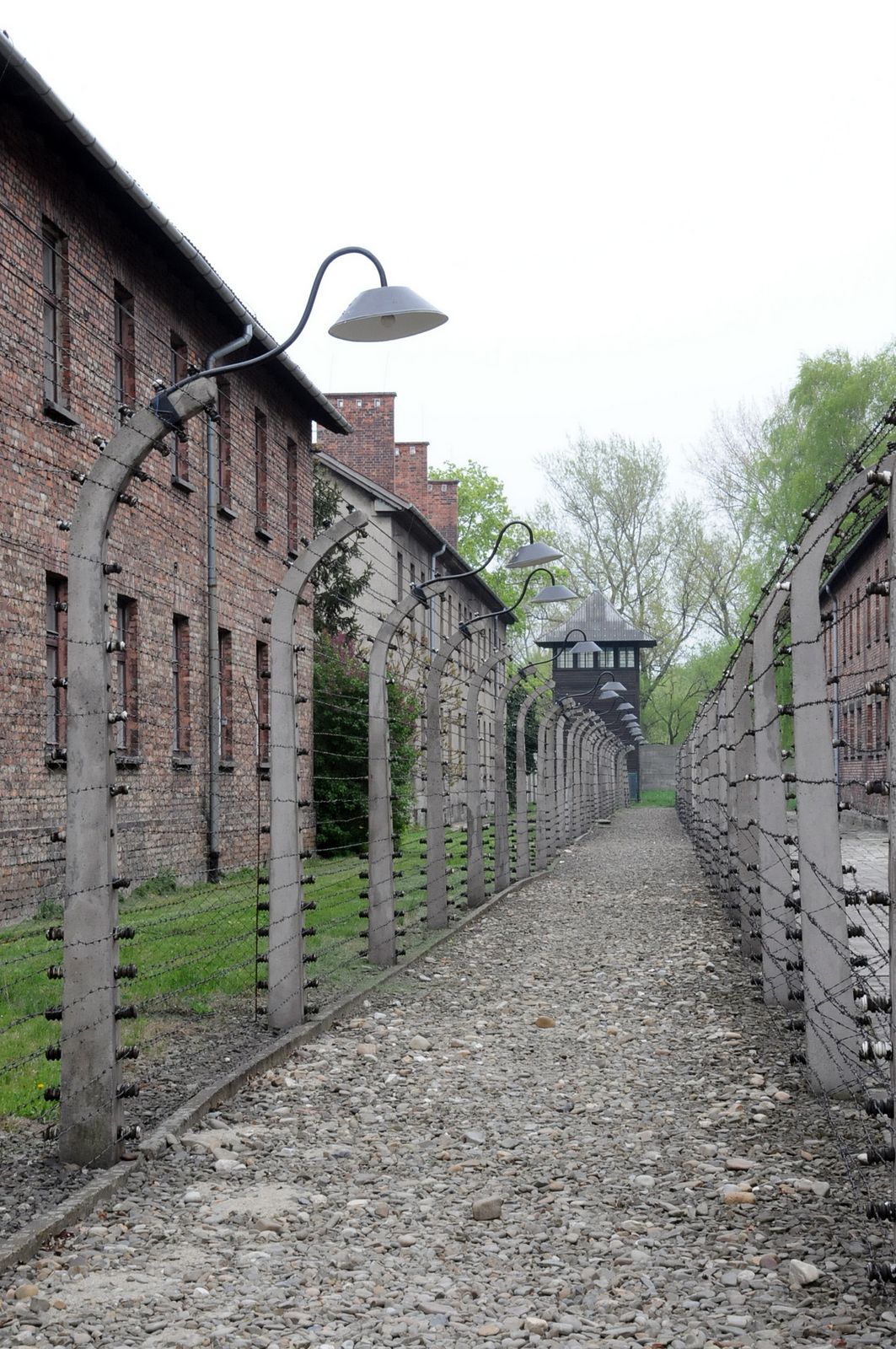
It’s easy to forget I’m surrounded by 200 college students, who have all been brought to this gloomy corner of Europe’s darkest shadow to learn more about the horrors of genocide that took place here. They’ve come from across the South West, including 10 young people from Bristol, as part of a government- funded project, run by the Holocaust Educational Trust, which aims to prevent the atrocities of World War Two ever being forgotten. The trust hopes to eventually be able to offer places to at least two pupils from every school in the UK – encouraging them to return to lead assemblies and group seminars in school.
They must feel a long way from their schoolmates as we arrive at Krakow airport and climb on board the coaches that will take us to the remote Auschwitz-Birkenau camp. The cheerful faces of the 17 and 18-year-olds suddenly turn sombre and grey as they find themselves walking beneath the sinister sign in wrought iron at the entrance – it reads “Arbeit Macht Frei”, or “work makes you free”.
We are led quietly through the maze of red brick buildings of Auschwitz I – the original section of the camp, which was later dwarfed by Auschwitz II, Birkenau, when the Nazis increased the pace and scale of their “Final Solution” towards the end of the war.
The courtyards of the original camp are eerily silent, but inside a series of starkly simple exhibitions demonstrate the enormity of the crime against humanity that took place here. It is the poignant piles of victims’ shoes, spectacles and baby clothes that provoke the biggest response.
“It’s really very shocking,” says Sophie Stoddart, 17, a student at Redland High School for Girls. “In one room there was just an enormous pile of women’s hair, which was shaved from their bodies after they were taken from the gas chambers. They used the hair to make stiffening for the uniforms of the German soldiers.
“Somehow seeing their hair brought them back to life to me,” she adds, choking back her emotions. “When you just see people in old black and white photos, on one level you don’t fully realise they were real people like you and I. But then you see their hair, looking exactly as it did the day it was shaved off their heads. That really brings it home. These were real people.”
As we wait to join our coaches, which will take us on to the second part of the camp, I meet Clifton College student, Daniel Odutola, 17.
“What got to me, was when I discovered the camp commandant lived here with his wife and five children. The idea that anyone could bring up his children in this place of death is shocking to me,” he says. “You can’t comprehend how people can do this – how humans can kill their fellow humans on such a cold and industrial scale.”
But the true scale of the atrocities only became clear to us as we arrived at Birkenau, the second Auschwitz camp a mile away.
From high up in the iconic watchtower, you can see the scale of the grisly project – the camp stretches for as far as you can see; row after row of huts, and the twisted remains of the factory-like gas chambers. The train lines which carried the victims of the genocide to their fate still cut a swathe into the complex.
It was here the guards divided the new arrivals – largely Jews, but also other so-called “non-desirables”, including homosexuals, gypsies and political prisoners.
“We saw the place where the men of working age were separated from the women, children, elderly and disabled people,” says 17-year-old Sumaya Ahmed, a student at The Red Maids School. “The men were set to work, but the rest of the new arrivals would be dead within an hour of arriving at the camp. You can’t imagine the horror of that separation. But this trip helps you to get your head around it. Somehow actually being here makes it all real.”
Fellow Red Maids student, Hannah Davis, 17, adds: “Even when they try to prepare you for what you’re going to see at the orientation seminar, it doesn’t dawn on you just how shocking it’s going to feel when you’re here.
“Seeing the cases full of baby clothes shocked me most. It’s devastating, but that’s why it’s so important to see it. It’s important our generation learns from the past, so it won’t happen again.”
Survivor testimony
Ahead of the trip to Poland, I joined the students as they met Auschwitz survivor Zigi Shipper. He was 79 years old at the time we met him. Zigi was just 10 years old when war broke out and his native Poland was overrun by the German army.
“It’s important for me to talk to young people about what I went through,” he says. “I think back about what happened to my family, and to the millions of entire families that were wiped out. Who will speak for them? Young people are the future, so they must know what happened in the past.”
Zigi agreed to talk to the youngsters at a special orientation event, ahead of their trip to Auschwitz. Students from Bristol took part in the trip organised by the Holocaust Educational Trust.
“When war broke out everything changed over night,” Zigi told the students. “I had grown up in the city of Lodz – a large industrial city which had a population of more than 250,000 Jews before the war.
“I was brought up by my grandparents, because my parents were divorced. I was told that my mother had died, because there was so much shame attached to divorce in our community. But I would later find out that this was untrue.
“My father came to me one day before the war and said that if the Germans invaded all the Polish men would be killed, but he assured me that the children and the old people would be unharmed. How wrong he was.
“Six weeks later, the Germans did arrive. Life was put on hold for Jewish people in the city. Men weren’t allowed to work. I wasn’t allowed to return to school after the summer holidays.
“After a few weeks we were forced out of our comfortable, three-bedroom apartment, and found ourselves having to live in a single room in the middle of the new Jewish ghetto.
“I was given a job at the local metal working factory. But life in the ghetto was hard. People were dying each day of malnutrition. I remember having to step over bodies in the street each morning to get to work.
“In 1942 the Nazis said they needed 70,000 Jews to leave the ghetto to go and work. By then my grandfather was dead – he died of malnutrition – so it was just my grandmother and I.
“I was still only 12 years old, but I was chosen for the work, and was slammed into the back of a lorry by a German soldier. When he went back into the building to get more people, I jumped off the lorry and escaped down the street. It was terrifying because I knew the Nazis would shoot me in the back if they saw me running.”
After hiding in an abandoned house until nightfall, Zigi was able to return to his grandmother for a few more years.
“Eventually I got called away again. It was 1944, and I was just 14 years old when I was sent to Auschwitz. At the time, we’d never heard the name Auschwitz, and we were told we would be all put to work for the war effort.
“But when I arrived at the railway station, I realised something was wrong. There wasn’t a normal train there – just dozens of cattle trucks behind a locomotive. I thought, they can’t put us in them, but of course, they did. They crammed us in, and as we travelled across Poland, they would occasionally stop and remove the bodies of those that had died enroute.
“The terrible thing was, each time someone died, it meant more room for the rest of us. I can remember hoping more would die, so that I might be able to live. The experience was dehumanising me enough to feel that, and I still feel guilty for having that thought today.”
Upon arriving at Auschwitz, the people on the train were immediately divided into two groups.
“The guard sent children and disabled people and the elderly to the right, and those who were capable of working to the left. Those that went to the right were executed within minutes of arriving.
“Many women wouldn’t be separated from their children and they were shot in front of us, along with their children. I’d seen such horrible things already by this point, but I couldn’t believe I was seeing children killed before my eyes for no reason whatsoever.”
Zigi was kept with his fellow metal factory workers at Auschwitz.
“Our clothes were taken away and we were showered. As I was given the now famous striped pyjamas, I realised I no longer owned anything. I didn’t even have a name, just a number: 84303.”
After a few weeks the group of metal workers were moved to another concentration camp, near Danzig, where they were set to work.
It was the first in a series of moves around occupied Europe, which Zigi suffered during the remaining years of the war.
By the time he was liberated by the British army in 1945, he had almost died of typhus and malnutrition.
“When the Germans realised the Allies were near, they sent us on a 10 mile death march – if you fell, they shot you. I was so ill, but luckily my friends kept hold of me so that I didn’t stumble and fall to my death.”
He remembers the day of his liberation – May 3, 1945 – as one of the happiest moments in his life.
“The Allied planes came over and bombed the area,” he says. “And then the next thing I knew the Germans were gone, and was surrounded by British tanks.
“I asked a British soldier for water, I spoke in German, but he understood and handed me his canteen of water. It was a wonderful feeling.”
After months recovering in hospital, Zigi had to decide what to do with his life.
“My grandmother had died in the Terezin concentration camp near Prague, and I never heard where my father was killed. So I was alone. I thought I might go to live in the newly-created Israel, like many of the others. But then I had a letter from a woman in London. My grandparents had told me she was dead, but my mother had been alive all along, and had moved to England when she was divorced. She had found my name on a Red Cross list. After much soul-searching I decided to come over to England and live with her. That’s when I made this country my new home.”
Zigi Shipper died in 2023 at the age of 93.
The above article was written by David Clensy in 2009 for publication in the Bristol Evening Post
 davidclensy.com