Thanks to the Military Thriller Book Group for featuring me in their author Q&A this week! If you don’t already follow the group, check them out on Facebook. Over the past week they have been running a series of Q&As with authors who feature “non-traditional protagonists”.
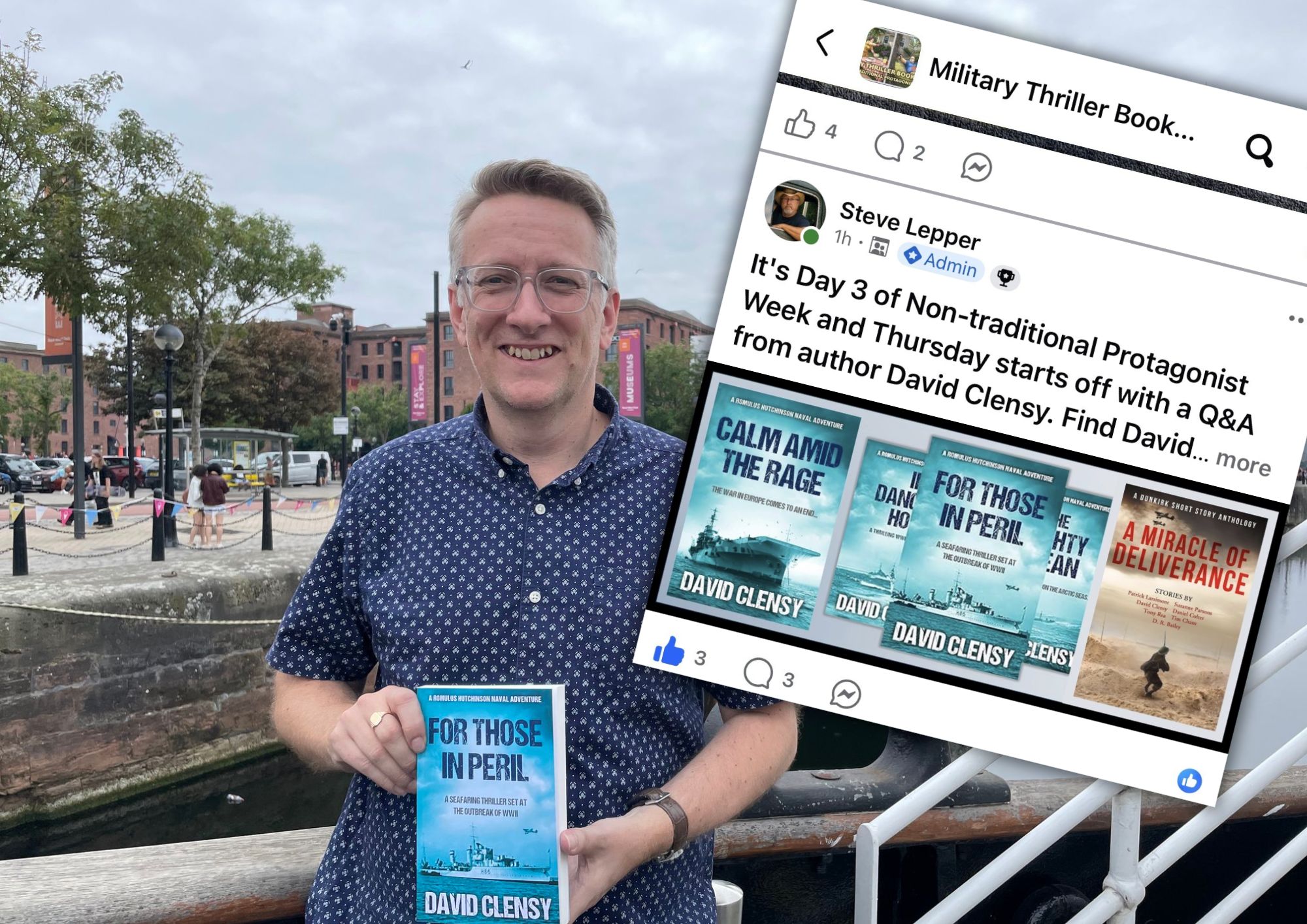
Given how rarely the Merchant Navy takes centre-stage in the genre, I spoke with Steve Lepper from the group about the Romulus Hutchinson Naval Adventure series.
- How and why did you start writing?
I first started taking seriously the idea of writing fiction during the long quiet weeks of isolation enforced by Covid lockdowns in 2020-21. I had been a professional writer for more than two decades. But as a journalist and later a copywriter, I had always focused on fact rather than fiction. But the aspiration to write a novel had always been bubbling at the back of my mind. There was always an absurdly confident sense that I would do it ‘at some point’. I had attempted a novella more than a decade earlier and had written the occasional short story. But at that time, the scale of a novel had felt intimidating, and so naturally, I kept putting it off.
My debut novel, Prayer in Time of War, was finally released in February 2024. It tells the story of elderly veteran Ernie as he returns to an Italy transformed from his experiences during the Second World War, in search of the girl he left behind in the back streets of Naples half a century before.
In July 2024, I signed a five-book deal with historical fiction specialist Sapere Books to deliver a series of World War II naval thrillers. For Those In Peril, the first book in the Romulus Hutchinson naval adventure series, was published in 2025. It follows the fortunes of Liverpudlian twin brothers Romulus and Remus Hutchinson (Rom and Remmie) as they get to grips with life at sea in the Royal Navy and Merchant Navy at the outbreak of the Second World War, little imagining the horrors that lay ahead.
The second book in the series, In Danger’s Hour, was released in November 2025, following hot on the heels of For Those In Peril. The Mighty Ocean, came out at the end of February 2026, followed by The Restless Wave in May 2026. The final part of the series, Calm Amid The Rage, is due out in September 2026.
In terms of why I started writing fiction – I think it was all about clinging to the past.
My first novel, Prayer in Time of War, was loosely inspired by my maternal grandad’s wartime experiences serving with the Cheshire Regiment in the Italian Campaign. When I was offered the chance to write a five-part naval adventure series set in the Second World War, I began to hear my paternal grandfather’s voice echoing down through the decades. While the Hutchinson family at the heart of my series is fictional, one of the twins does serve on the ss John Holt alongside my grandfather, who was chief engineer on the ship during the war. So my grandfather is briefly resurrected by my pen for a cameo in the story. Later in the series, my maternal grandmother also makes a brief cameo in the story when her home is bombed in the Blitz. It’s just too tempting not to conjure their lives back into existence, however fleetingly, with a few strokes of the keyboard. - Could you give us a brief description of your latest (or debut) thriller?
My latest to be published is The Restless Wave. Rom is now a first lieutenant, rapidly getting the chance to show his mettle on the bridge, seeing action in the Mediterranean for the Allied landings at Sicily and Salerno, as well as helping to lift the siege of Malta as part of Operation Pedestal.
Remmie, meanwhile, is once again unlucky enough to experience the wrong end of a torpedo strike. Following the attack, off the mouth of the Opobo River on the African west coast, the U-Boat surfaces to take prisoner Remmie’s captain and senior officers, leaving the men to watch the ship sink into the crocodile-infested waters. Rom is more than a thousand miles away, oblivious to Remmie’s plight.
My latest in terms of what I’m currently writing… I have recently signed with Sapere Books for a second series. The U-boat Aces series will be a sweeping, character-driven saga that charts the rise and fall of Germany’s submarine elite across two world wars. Spanning three decades, from 1914 to 1945, the five-book series will follow a handful of officers from idealistic cadets to disillusioned veterans, set against the relentless evolution of undersea warfare – from improvised beginnings to industrialised slaughter and ultimate collapse. Readers will travel the world alongside some of history’s most ruthless U-boat commanders, in a series that will be charged with the claustrophobic conditions of life aboard the German U-boat fleet. I’ve finished writing the first book in the series and recently started work on the second book and (if I’m allowed to say this as a writer) I’m completely engrossed.
The first in this new historical thriller series should be out at some point next year. - Why a non-traditional protagonist?
With the Romulus Hutchinson naval adventure series, I used a combination of “real” characters – based on actual people, alongside fictional characters, including my twin protagonists. I wanted them to act as “everyman” characters – who might represent any one of the millions of young men who signed up to serve in the Royal Navy and Merchant Navy in the Second World War. When we meet them, they are still boys, as yet untouched by the weight of history that is to fall on their shoulders.
It was important for me that they did not come across as “heroes”, but as real people who faced this world-shattering conflict. As Umberto Eco wrote: “The real hero is always a hero by mistake; he dreams of being an honest coward like everybody else.” - Recommend a non-traditional protagonist book/film/TV show?
I’m an enormous fan of Len Deighton, and think there is possibly no finer non-traditional protagonist than the nameless character who, in the films, became known as Harry Palmer. The IPCRESS File, Horse Under Water, Funeral In Berlin, Billion-Dollar Brain – all the Harry Palmer novels are fabulous. The character spends much of the novels as exactly that sort of “accidental hero”: a capable man dragged into events larger than himself, succeeding through intelligence, stubbornness and professionalism rather than bravery or idealism. - When not writing, you are?
Reading or walking in the rolling chalk downlands of Wiltshire, in south-west England. - Describe your writing process (research, outlining…):
I recently spent a few days travelling around northern Germany, researching the finer historical detail for the U-boat Aces series – travelling from Hamburg’s bustling port, to the remote island of Heligoland, from Bremerhaven on the North Sea coast, where I would get to explore a Second World War U-boat, to Wilhelmshaven in Lower Saxony, where at the excellent Deutsches Marinemuseum, I would spend hours picking through the relics of the U-boat aces’ lives. I believe that with historical fiction, the devil is in the detail – and that kind of detail can only come from putting in the legwork with this sort of research trip.
But when I start writing, it’s about sitting down at my desk in my little home office, closing the door, and simply getting it all down on to the computer screen. I normally try to write 5,000 words a week – often working into the evenings and early on Sunday mornings. I normally have Mozart’s Requiem in D Minor playing when I’m writing. It helps, for some reason. - What are your writing goals for the rest of 2026?
I’m looking forward to seeing the fifth and final part of the Romulus Hutchinson naval adventure series coming out in September – I think fans of the series will enjoy Calm Amid The Rage, which aims to tie up all the loose ends of the series.
I also have a piece of narrative non-fiction coming out at the end of October – Walking Wiltshire’s Chalklands, and am hoping to get the second novel in the U-boat Aces series written before Christmas. I’m very excited about seeing that series continue to take shape next year. - What did I forget to ask?
How about: how did 20 years of writing newspaper journalism shape your fiction writing? Great question! It made me realise that everyone has stories to tell.
On my very first day as a trainee reporter on the Derby Telegraph, I was given the ancient Derbyshire Dales mill town of Belper as my “patch” and immediately told to head out there to “find a story”. I thought it would be impossible. Surely nothing happened in a little town like Belper? But within minutes of parking up in the town, I got talking to the town crier (it seemed like a good place to start). He told me he had just been banned from the town’s streets for being too noisy in his delivery. Surely this would make tomorrow’s front page news, I thought, and eagerly began to scribble down quotes.
But minutes later, I managed to trump my own story. At the end of the interview, he mentioned that if I wanted a really good story, I should be talking to his neighbour Avis Ratcliffe. Dutifully I got back into the car and searched out the address. The 77-year-old chuckled when she answered the door and invited me straight inside, more than happy to tell me all about the excitement of her morning. She had been visited that day by the local bomb disposal squad after a visiting friend, who had military experience, had picked up the First World War hand grenade she had kept above her fire place as an ornament for years.
“I’ve polished it every week for 57 years without knowing I was dicing with death,” she said.
At that point, I knew that not only had the town crier story been relegated to page three of the next day’s newspaper, but more profoundly, I realised the world was crammed full of remarkable stories behind every door on every street.


Leave a Reply