Novelist David Clensy reflects on what it is like to stand in the queue as a reader at a book signing
Never meet your idols – it’s the classic piece of advice that gets regularly churned out. But when it comes to literary events, as readers, we find ourselves coming face to face with some of our favourite authors. It can be curiously dislocating. After all, here is an individual to whom you feel truly connected – the reader/writer relationship is one of the few in which we get to spend time “inside the head” of another human. Yet of course this is a one-way relationship – in reality, they are complete strangers. At least, we the readers are complete strangers to them.
As a reader I enjoy attending author events, where I can sit and listen to a writer I admire talking in detail about their work, perhaps having questions put to them and perhaps reading a few pages from their latest work – not least because of the depressing absence of such cultural content on television and radio today. I attend many of these events, and from the other perspective, as a writer, I am occasionally lucky enough to be invited to speak at such events myself.
As Sebastian Barry said at an author talk I was at in Bath earlier this week, as he looked out across the room of like-minded literature fans: “isn’t it wonderful we’re all here”.
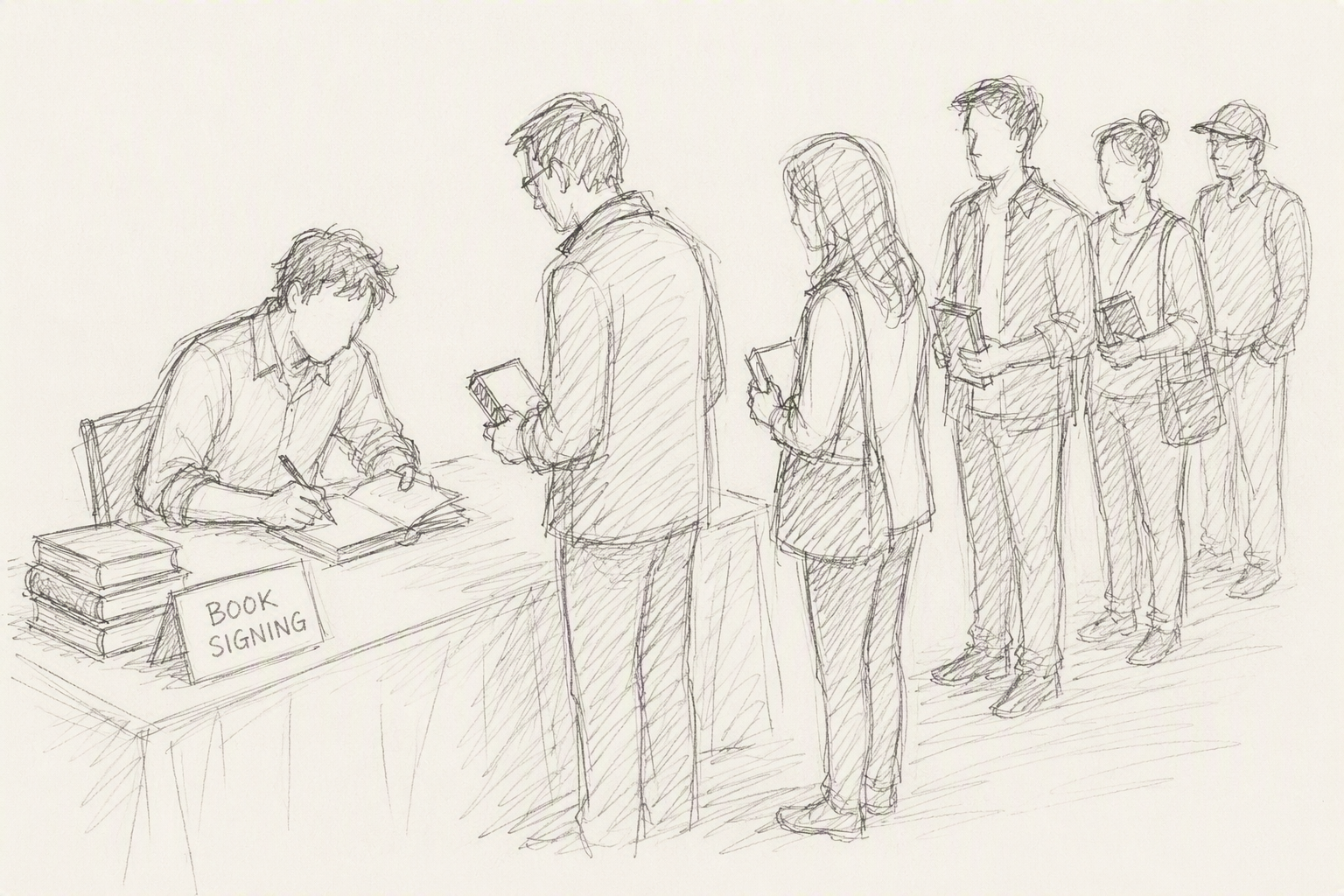
But I find such occasions also create a tension for hopeless introverts like myself. Things get particularly tricky at the book signing that inevitably occurs after the talk or the Q&A. Sometimes books are sold in advance of the start of the talk pre-signed by the author and attendees are simply given the opportunity to queue up and meet the author afterwards to have their signed copies “dedicated”. When this is the case, I never join the queue – the sheer social anxiety of making small talk, even briefly, with an author whose name takes pride of place on my bookcase is simply too much to contemplate. I creep away. But if the book isn’t pre-signed, I sometimes pluck up the courage to join the queue. I’m not entirely sure why, but we all love owning a signed copy of a book, don’t we?
The curious psychology of this anxiety is that on paper, I should not be a “shy” person in these kinds of scenarios. I am a grizzled, middle-aged man – not a wide-eyed teenager. I spent 20+ years as a journalist, so interviewed scores of famous people when working for newspapers. Equally, as a novelist myself, I feel no great trepidation about being on the other side of the desk at these book signings. But critically these are both situations in which I have control – whether as a journalist leading an interview, or as an author leading an event. As a reader queuing up to meet my own idols, that control is taken away. You will find me hiding in the back row.
The reader/writer relationship is one of the few in which we get to spend time “inside the head” of another human.
David Clensy
I don’t have the “permission” to ask questions, as I did as a journalist, nor do I want to be the one who turns up and says “I’m also a writer, so I wondered…” before posing a question. What could be more cringe-making than framing a conversation along those lines? I can almost see the roll of the eyes. So I find myself waiting in line, as the author in question is having deep and meaningful conversations with everyone in front of me, wondering what on Earth I might say when I reach the front of the queue. The more I consider it, the less my brain seems to work. I go blank. I’m not good at “small talk” at the best of times, but under the kind of stress that comes from “you have one chance to make this a good experience”, my mind simply freezes. I can barely speak, let alone hold a conversation.
I’ve experienced this phenomenon a few times before. When it happened with Louis de Bernieres, I found myself thinking – this is the man who wrote Captain Corelli’s Mandolin, perhaps the very book that I read as a teenager that truly set me on a course to wanting to write historical fiction. But did I tell him this when I reached the front of the queue? Of course not. I simply handed over my book, smiling like an imbecile, and tripping over my words even as I attempted to tell him my name so he could inscribe the dedication. I walked away feeling horribly deflated on that evening, through no fault of Louis de Bernieres.
I had the same experience again this week. As I waited in line to meet Sebastian Barry and have him sign my newly purchased copy of his wonderful new novel, I could hear him laughing and joking or having seemingly thoughtful dialogues with every single person ahead of me. How were they doing it? I felt the rising pressure to “perform”. But predictably, when it was my turn to advance up to Barry’s makeshift desk, I handed across my copy of the book, murmured a feeble “thanks so much” and grinned at him like a buffoon.
What can I possibly say… that won’t sound like utter guff?
David Clensy on meeting one of the greats of Irish literary fiction
But unlike de Bernieres, Barry did not simply carry on with the chore of signing my book and dispatching me politely. He looked up and held my gaze for a very long time. Neither of us spoke. The panic was bubbling in my chest like Alka Seltzer – was I really expected to initiate a deep conversation with one of the great minds of 21st century literary fiction? Then he leaned closer, as if studying my face.
‘Dear God,’ he said at last. ‘You have the look of a Barry about you. God help you. I have a first cousin who looks just like you. For a moment there, I thought you might be him.’
With this conversational opener as a generous gift, I should have easily been able to gabble something about Irish blood and ancestry, but nevertheless my tongue-tied state did not ease. It was all I could manage to thank him for signing the book. ‘You’re very welcome,’ he smiled. I walked away, realising I hadn’t even mentioned I was looking forward to reading it.
We writers tend to be natural introverts. But this is never more the case than when faced with another writer – especially one whom you have already placed on a far more elevated pedestal. It leaves my subconscious with a single question – what can I possibly say, standing before this genius, that won’t sound like utter guff? My subconscious fails to reason that by saying nothing at all, I look like even more of an imbecile.
The only comfort as I walk through the darkened streets of the city on my way home, is that surely the mind that crafted such sensitive and profound pieces of literary fiction, the person I have been listening to all evening speaking so eruditely and articulately about the trials and tribulations of human life, would surely understand.


Leave a Reply